Almost every conversation about synthetic faces or voices, in the press, in policy rooms, in the abstracts of the papers I’m about to praise, asks can people tell the difference? Detection accuracy is the headline. It makes a paper publishable and a threat feel real.
But detectability is a misleading number.
The question "Can you tell?" collapses a stack of loosely-coupled cognitive systems into one binary "good"/"bad" readout, which it isn't.
Four papers from the last couple of months, seemingly asking the same question and getting different results, highlight this point in a way I couldn't resist but to use to explain the importance of nuance in methodological testing and why a single number story should never be enough for decision makers.
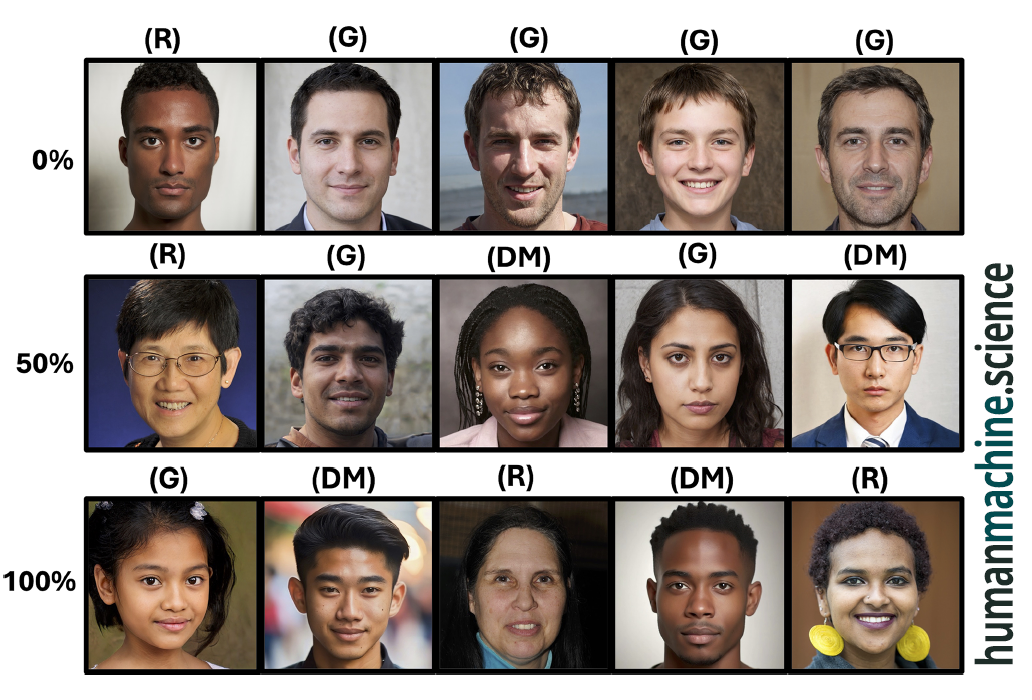
Criteria: Ours and Theirs
Studying consciousness, we learned that “detectability” means many different things (see our “Studying unconscious processing: Contention and consensus” paper).
When a word flashes on the screen, possibly invisible, or under the threshold of conscious awareness, we can measure whether you noticed “a” change, the appearance of something, letters vs. symbols, English vs. Greek letters, words vs. gibberish, etc.
We can do any of these through verbal reports, yes/no per trial, 2 alternative forced choices (2AFC: did you see it in the first or second duration? left/right?), eye tracking, or brain imaging.
Passing different criteria would be considered “detection” in different contexts, each meaningful in a different way.
When a face hits your visual system, we can look, again, at many different levels:
- Did your V1 areas fire “Something happened”?
- Did your FFA (assuming you’ve got one) shout “face detected”?
- Did your cortex discriminate it as real or synthetic?
- Was it evaluated?
Male or female?
Young or old?
trustworthy? warm? competent? attractive? ... - Did any of these reach your consciousness?
- Will you remember it?
Detection research measures a single layer and calls it a day. But behavioral effects can be found anywhere from layers 2 to 6. Each of the four papers below is really a report about two of these layers misaligned. That refusal, the dissociation, is the finding. Average it away and you’ve measured nothing.
What Does Research Say?
Dawel and colleagues at the ANU Emotions and Faces Lab (PNAS, 2026) took people who couldn't tell generated (StyleGAN3) faces from real ones, and without ever telling them what to look for, trained them to attend to global impressions: how typical, symmetrical, distinctive a face feels. Accuracy nearly doubled, to 81%, and confidence started tracking accuracy after training. The fact that training work reveals that the discriminating signal was arriving all along, layers 1 and 2 were catching it, and simply wasn't reaching the next ones.
Go up one floor, and Proverbio and Dosaikina (Scientific Reports, 2026) show the signal can climb most of the stack and still never reach conscious perception. They recorded EEG while thirty people viewed real and GAN faces. AI faces misclassified as real, rated more familiar and attractive were not reported behaviorally. The cortex showed detection, but participants pressed a different button. Face-evoked ERP components separated AI from real faces reliably, even though the distinction was irrelevant to the task. Indistinguishable, as measured by behavior is simply not the same claim as unprocessed.
Sulimani, van Hunenstijn and Albonico (Perception, 2026) ran a two-alternative forced-choice memory task, chosen since 2AFC is more criterion-free than yes/no, so relative familiarity drives the choice rather than a personal threshold. AI faces were remembered better than real ones. Here, unlike in other findings, people could also classify real-vs-AI above chance (~65%). And the two abilities didn't correlate: how well you remembered a face told you nothing about whether you could tell it was fake. Memory preferentially latched onto synthetic faces while conscious classification ran on a separate track.
And finally (for this point in time, this one was published this week), McGuire, Bohacek, Farid, Taylor and Nightingale (Journal of Vision, 2026) presented participants with Real, GAN, and diffusion faces. GAN faces were hardest to catch, with 48% accuracy, slightly below chance. Diffusion faces were easier to flag as synthetic. Then a second group rated the same faces for trustworthiness, and the ranking flipped: real faces were the least trustworthy, followed by GAN, and diffusion faces, the ones people were best at spotting as fake, were the most trusted. The face you can most easily tell is synthetic is the one you’d most readily hand your money to.
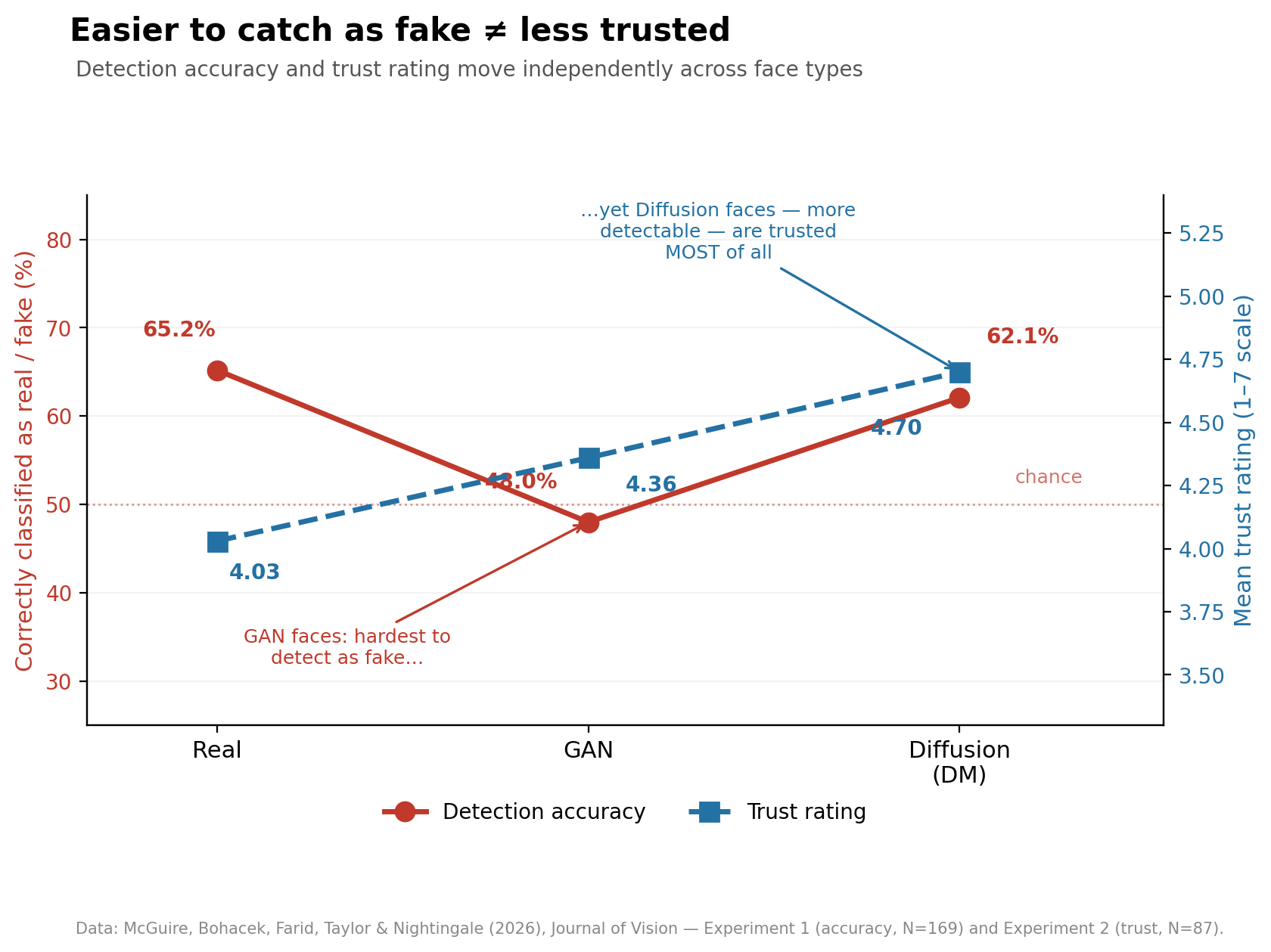
Chart is my own, plotted from summary statistics reported in McGuire 2026.
Together, these four say something none of them says alone. The signal is present at the bottom and unused (Dawel). It climbs the cortex and never reaches report (Proverbio & Dosaikina). It shapes memory without informing judgment (Sulimani et al.). And judgment, when it finally happens, runs orthogonal to trust (McGuire et al.). “Detectability” isn’t one construct. It’s a convenience label stretched over different systems, each relevant to different groups and usecases, and the harm rides on the layers the detection question doesn’t measure.
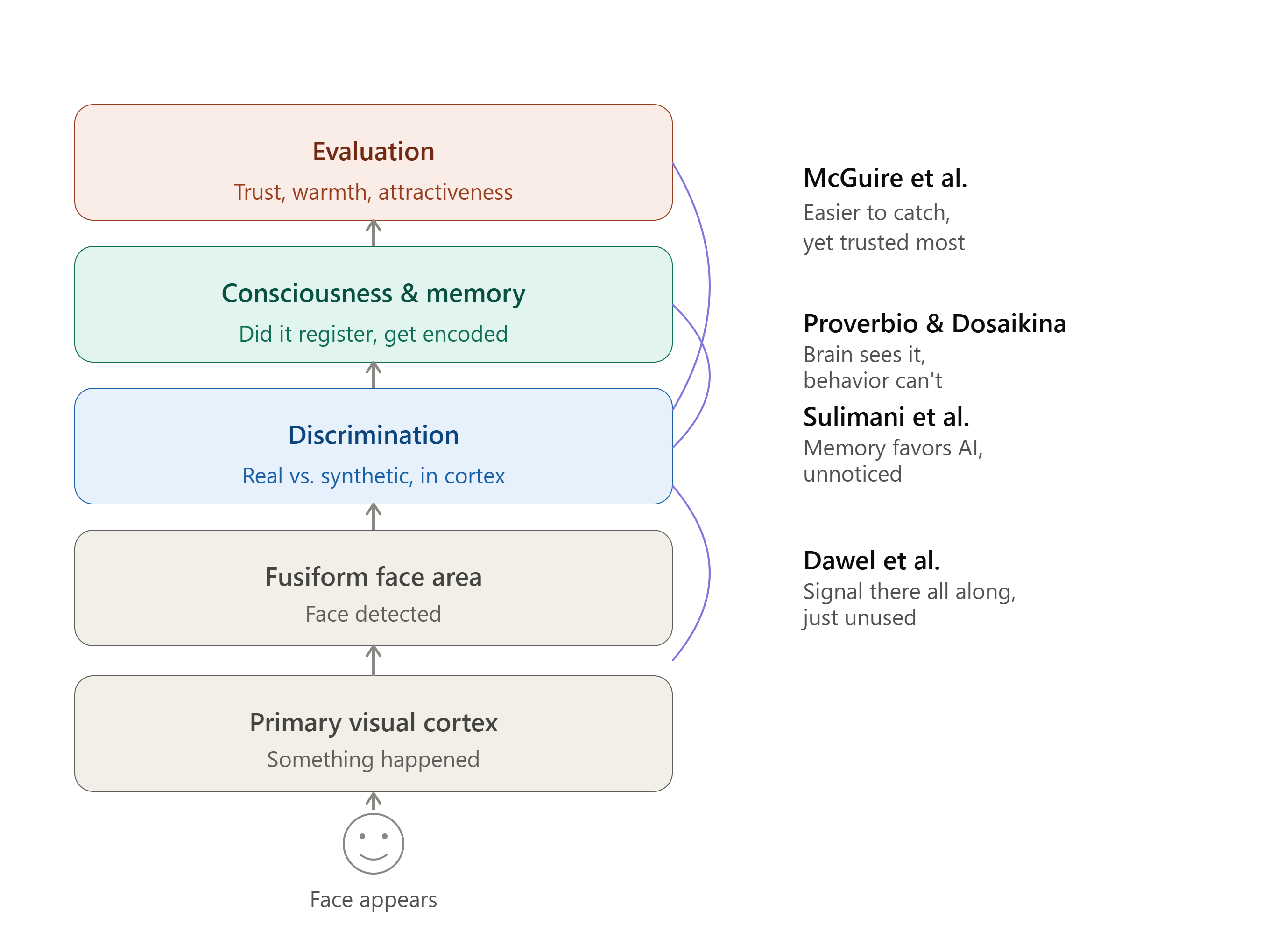
Notice that none of these findings required a better detector (or generator, depending on whose side you're on). Every one came from measuring humans, and specifically from refusing to trust a single behavioral number. That’s not a disciplinary badge, and I’m not making a guild claim for psychologists. It’s a portable toolkit, and it belongs to anyone trained to study humans: a cognitive scientist, a psychophysicist, a consciousness researcher, an ML engineer who has actually read this literature rather than skimmed the leaderboard.
The Benchmark We Need & The One We Deserve
If you’re deciding whether a synthetic-media risk is “under control,” one accuracy figure won’t tell you.
A defensible battery reports, at minimum: explicit classification decomposed into d′ and c; an implicit memory measure; explicit social-trait ratings (trust, competence, attractiveness); a neural or physiological measure where feasible; and, the step almost everyone skips, a downstream behavioral outcome. Does the elevated trust rating actually predict someone sending money, sharing data, clicking the link? A trait rating is still one inference away from harm. Close that gap, or admit you haven’t measured harm at all. And then report the dissociations, don’t fold them into a single “safety score.”
The disagreements between layers aren’t measurement error.
These disagreements are the risk we’re looking for.
Why should we care about faces?
Faces are one of the most researched structures in psychology. We know a lot about how we process them, where, why and when. Here, the law they expose is general, and it’s the one that should worry anyone building systems people talk to: an AI’s effect on a person is not gated by that person’s ability to recognize it as artificial.
We keep reaching for disclosure as the safety lever- label the bot, watermark the image, tell the user “you’re talking to an AI.” Disclosure operates at some layers, it addresses conscious knowledge. But trust, warmth, attachment, compliance, the felt sense that someone is on your side, those live at other layers, and disclosure doesn’t have to reach them. We already know this from the therapeutic-alliance work: a working alliance can form with a system the user knows perfectly well is a machine.
Knowing didn’t switch the relationship off. It formed anyway, underneath the knowing.
So “did the user realize it was AI?” is the same impoverished question as “could they tell the face was fake?”, a single layer answer to a multy layered problem. A voice agent that discloses itself can still be trusted more than the human it replaced (follow for more details ;)). A companion the user calls “just a chatbot” can still restructure who they turn to at 2 a.m. The disclosure is honest and the effect is unmeasured, because we measured the layer that’s easy to measure and declared the rest handled.
That’s why this needs people trained to study humans across the stack, not just people who can build a better classifier.
The question is not whether they can tell, It’s what the system does to a person who can or can’t. The brain may already know something is off. Whether we bother to measure what it knows, before deciding the system is safe, is a choice.
Right now, mostly, we’re choosing not to.