Ever notice how AI solves your problems, sparks your creativity, helps you come up with exciting out-of-the-box ideas, and at the same time turns everyone into repetitive, soulless robots?
Until 2022 (remember 2022?!), each of us lived inside our own cognitive bubble.
We had half-formed thoughts about whatever interested us, daydreamed a little, doodled now and then. What made that private bubble unique and interesting was that it was built from private associations. They’d spiral into thought loops, or the thinking would drain toward some point, and from there any progress felt like a flash of insight.
We actually know a fair amount about those flashes. They came from unconscious processing, fed by exposure to other material. Sometimes the distance was small enough that we could feel one topic helping us break the pattern. Sometimes it was far enough to feel like “cracking it,” or a leap of association. Sometimes it came to us in a dream.
Either way, even those flashes were products of our own thinking: serial processing of the same ideas.
Which raises the question: was any of that creativity?
So What Is Creativity, Anyway?
Psychology has no consensus on what creativity is. There are lots of definitions. Some of them are genuinely creative. My favorite: the ability to think of something associatively far enough away to be interesting, yet close enough to stay relevant. There are more objective measures, too (especially now, with language models), but the numbers matter less here.
So a creative person is someone who can take an idea far enough that we can still follow the leap, without it looking trivial. Leap too short: it’s neither new nor interesting. Leap too long: it’s unrelated.
A creative idea can develop slowly, in which case the result looks creative to whoever meets the leap for the first time. Or it can arrive all at once, and then the creator experiences it as creative too.
Picture thoughts as small islands scattered across many dimensions. Or two, if that’s easier. Creativity is the greatest possible distance between two neighboring islands that still lets you build a bridge between them.
In this model, boring people’s thoughts sit clustered in various regions, by field or interest, packed tightly together. Lots of people think them, partly because they echo them back to each other, and partly because they’re trivial thoughts.
The thoughts of the more interesting, more innovative people orbit those clusters a bit further out, linked by longer bridges that not everyone can see.
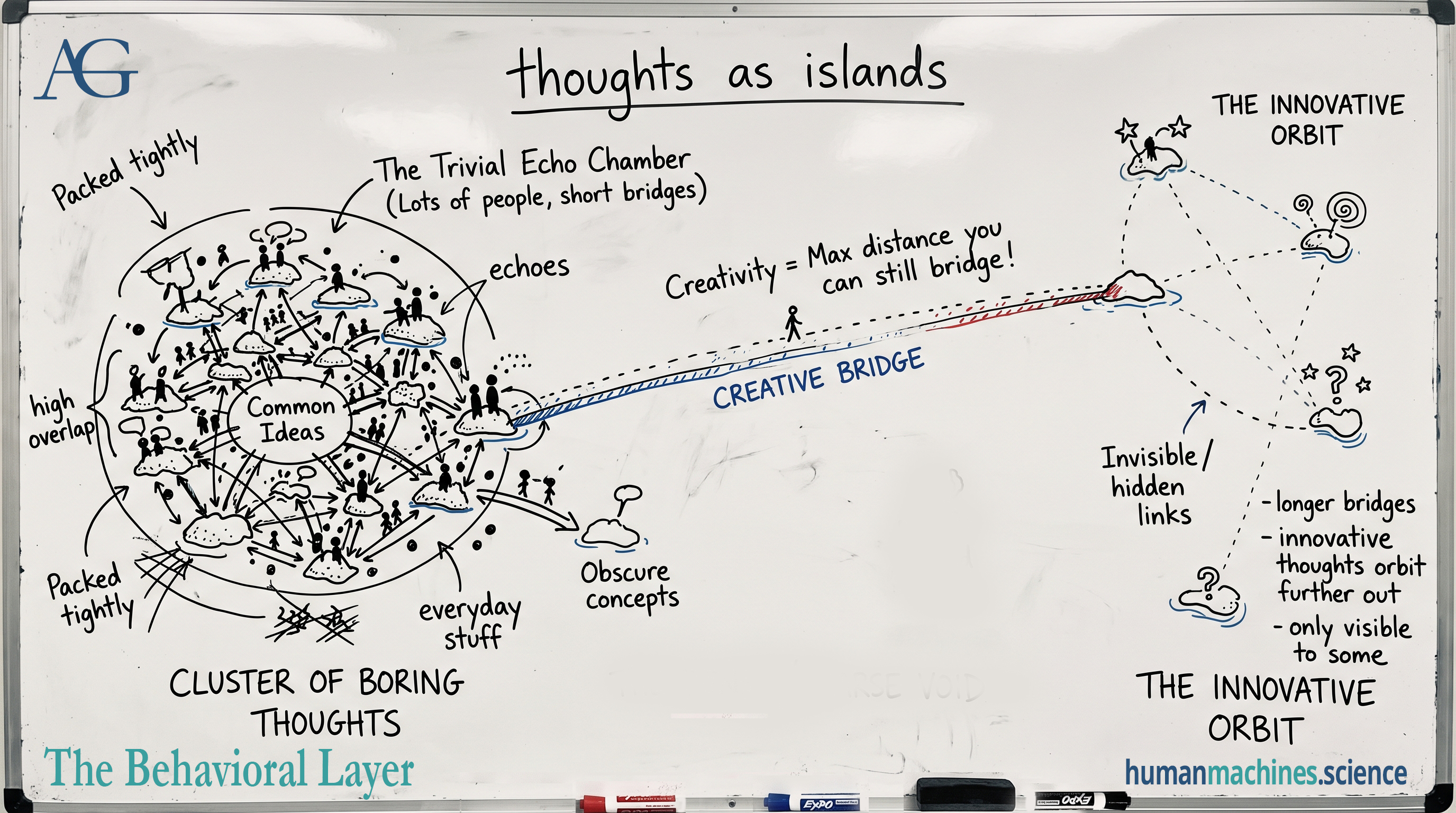
In other words, creativity is the ability to take a thought we’ve already been turning over, or some new detail, and throw it further than others would. Just not too far.
When we share an idea with someone, they can try to understand it within the space we’re speaking from, or take it into their own territory. If their territory is close enough to ours, we’ll feel they gave it a creative interpretation.
Then Came Large Language Models.
Language models let anyone toss in any bit of thought-noise, the tiniest, rawest start of an idea, and get back a “different, creative” answer. That means an answer further from what we’d have come up with on our own, because it’s closer to what the model knows, and what the model knows is the common denominator of all of us.
When we trained language models, we trained them on LOTS of thoughts, by both brilliant and non-brilliant minds from every field. Countless little islands poured onto the map, and the map learned to produce a clear, pleasant picture of the center of whatever topic is under discussion.
It’s not so different from telling our stories to someone with endless patience and a great command of language. Still, it’s something other than what we were used to.
So the model takes what we told it and places it at the center of the representation of thought. That center belongs neither to us nor to our friends. It belongs to the world.
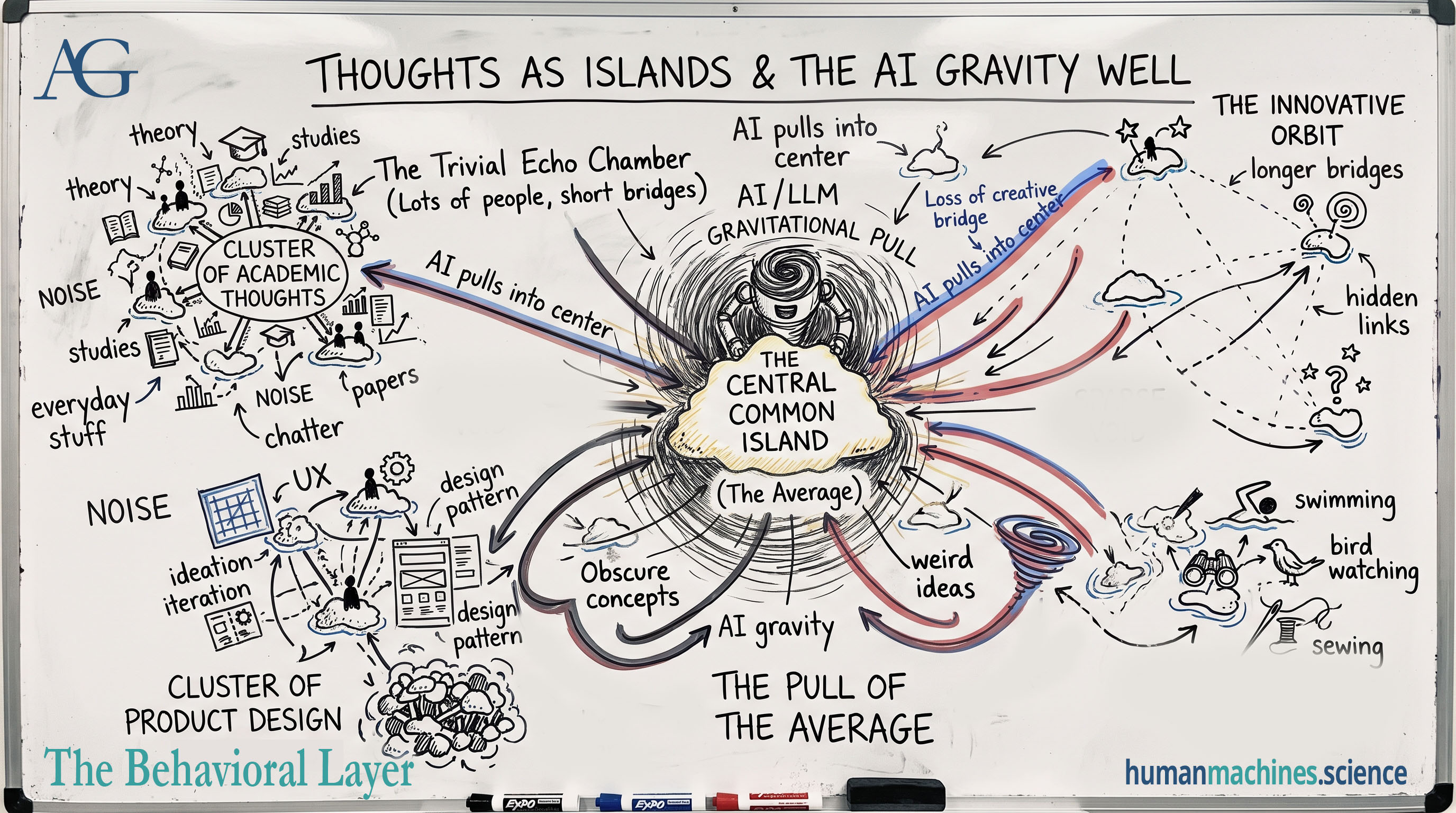
And we experience that as creativity. Because suddenly every small, unformed idea becomes a unique, magical essay, persuasive and vibrant. It’s all dressed up in three-part paragraphs that let us dive in, streamline, and delve deeper into the rich, multifaceted tapestry of our intellectual landscape — and in today’s fast-paced digital world, it’s worth remembering that, at the end of the day, this isn’t just a small shift; it’s a revolution.
(I wrote that sentence myself, too, cramming in as many words and moves as I could that have been worn to death in recent years. I have to admit it doesn’t look bad, even though it doesn’t really make sense. I just reread it: the associative logic is obvious, and there’s no actual content in there.)
Back to the point. If you’ve ever written under the influence of various substances (as a consciousness researcher I’m professionally obliged to admit I’ve tried them all, and as a law-abiding citizen obliged to deny it, and rightly so!), you’ll recognize something familiar: sometimes we’re so enchanted by the style and the flow that we don’t mind paying for it in direction, logic, or the quality of the argument.
This part, at least, is well studied. What feels natural and right, rhymes for instance, often falls apart once you stop and look at it (does an apple a day really keep the doctor away? If it doesn’t fit, must you acquit?).3. Language models excel in pleasant sentence completion. More than they do in creativity or sense-making.
So, back to our bubble. We’re stuck in there, unsure where to take our oh-so-brilliant ideas, because we’ve been inflating them ourselves. Then along comes a marvelous, sublime digital being that will happily listen until we finish typing (or dictating), and it also responds, more or less on point, in grand, colorful language. So it looks creative. And it feels good. Flattering, even.
And I know it may hurt your feelings, thinking about how it treats your thoughts just like anyone else's.
But it does.1,2
Why Can’t You See It Happening?
There’s another interesting effect we experience when writing or thinking with AI.
Take a look at the image below, then we’ll keep going.
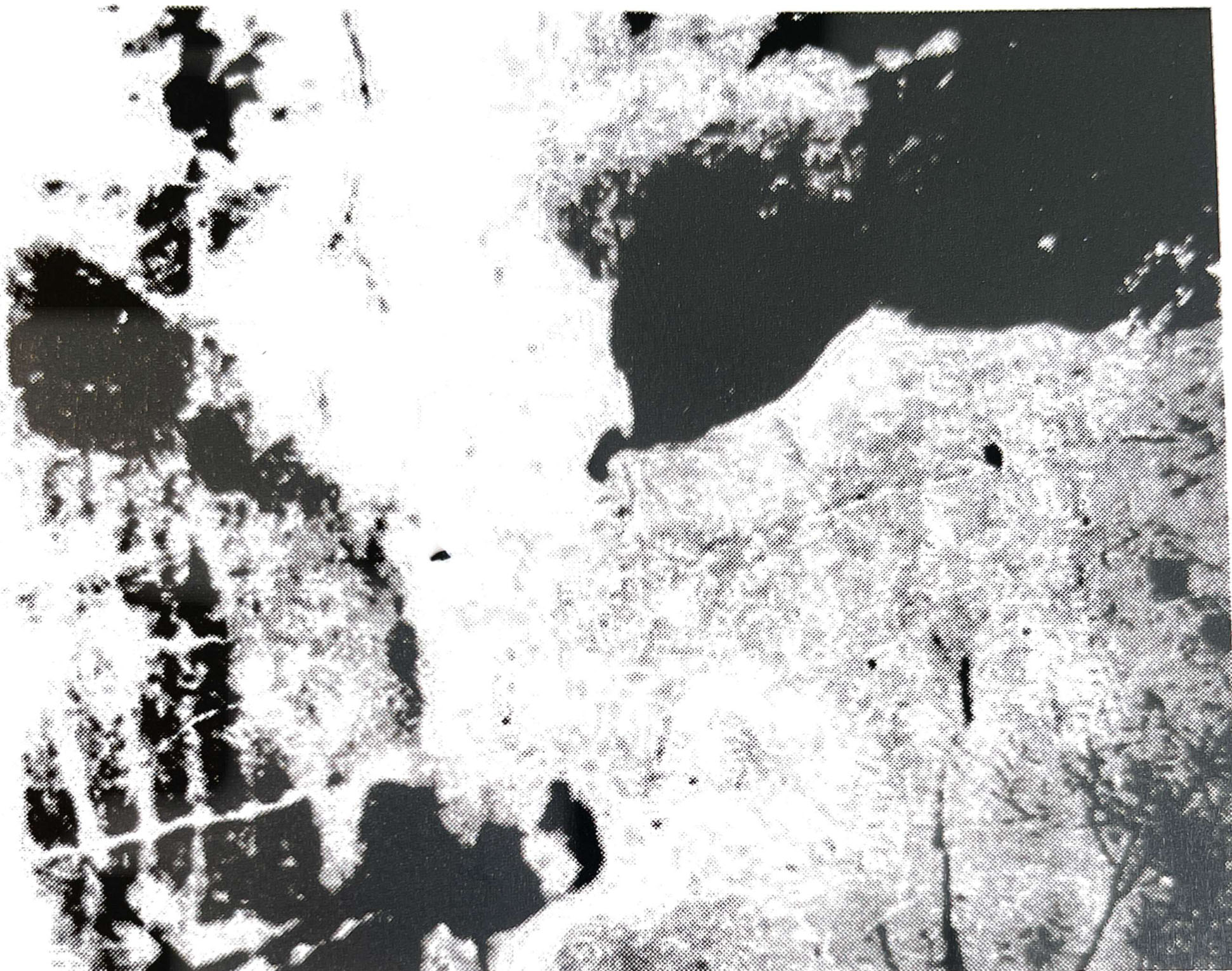
You see blotches. They’re not interesting. They just look like blotches.
If you’re into AI, they look like blotches.
If you work in content, they look like blotches.
If you’re into science, or art, or sports, they look like blotches.
Now for the magic. What if the thing you were into was farm animals? Cows, specifically?
Something in that picture just changed forever. What you know has reorganized what you see.
If the change is justified, and the cow is really there, we call it insight: an “aha” moment.4 If it lives more in your head than in the world, it’s pareidolia.
Either way, you can no longer imagine what it looks like to someone who doesn’t see it. That’s the curse of knowledge.5
And from the inside, there’s no way to tell which one it is.
The same thing happens in your writing and thinking. You had a great idea.
One you knew, and loved. Maybe even rightly so.
Then AI came along and turned it into something generic and warped, full of big words and slick prose.
And that’s wonderful. Except it isn’t your idea anymore.
To everyone else, it’s a weird, murky blotch.
The meaning stayed in your head, and you can no longer judge the text, because your knowledge and associations are still in there.
To any other reader, it sounds like word salad.
That’s why everyone now writes like the same clunky, uninspired robot.
And that’s why we’re losing the ability to think creatively, too.
So next time you find yourself stuck on an idea, know that it's okay. Cracking a tough problem takes time, but it's more satisfying and rewarding than anything AI will serve you up.
Still stuck?
Try getting creative by stepping outside the box. Go meet a stranger at a café because they impressed you at a conference, travel somewhere you've never been, or read a book written by someone else.
Language models can be great tools for finding sources, verifying information, or writing code.
Please, keep creativity human, until we train a model to do that, too.
This article was originally written and typed, word by word, by a human.Claude & ChatGPT helped me improve my English, Gemini drew some of the figures, and a mixture of them contributed to the research.
If you find any mistakes or typos, read them as evidence of my humanity, and feel free to comment on LinkedIn or by email.
References
- ↑ Doshi, A. R., & Hauser, O. P. (2024). Generative AI enhances individual creativity but reduces the collective diversity of novel content. Science Advances, 10(28), eadn5290. https://doi.org/10.1126/sciadv.adn5290
- ↑ Sourati, Z., Ziabari, A. S., & Dehghani, M. (2026). The homogenizing effect of large language models on human expression and thought. Trends in Cognitive Sciences, 30(9), 805–816. https://doi.org/10.1016/j.tics.2026.01.003
- ↑ McGlone, M. S., & Tofighbakhsh, J. (2000). Birds of a feather flock conjointly (?): Rhyme as reason in aphorisms. Psychological Science, 11(5), 424–428. https://doi.org/10.1111/1467-9280.00282
- ↑ Ludmer, R., Dudai, Y., & Rubin, N. (2011). Uncovering camouflage: Amygdala activation predicts long-term memory of induced perceptual insight. Neuron, 69(5), 1002–1014. https://doi.org/10.1016/j.neuron.2011.02.013
- ↑ Camerer, C., Loewenstein, G., & Weber, M. (1989). The curse of knowledge in economic settings: An experimental analysis. Journal of Political Economy, 97(5), 1232–1254. https://doi.org/10.1086/261651